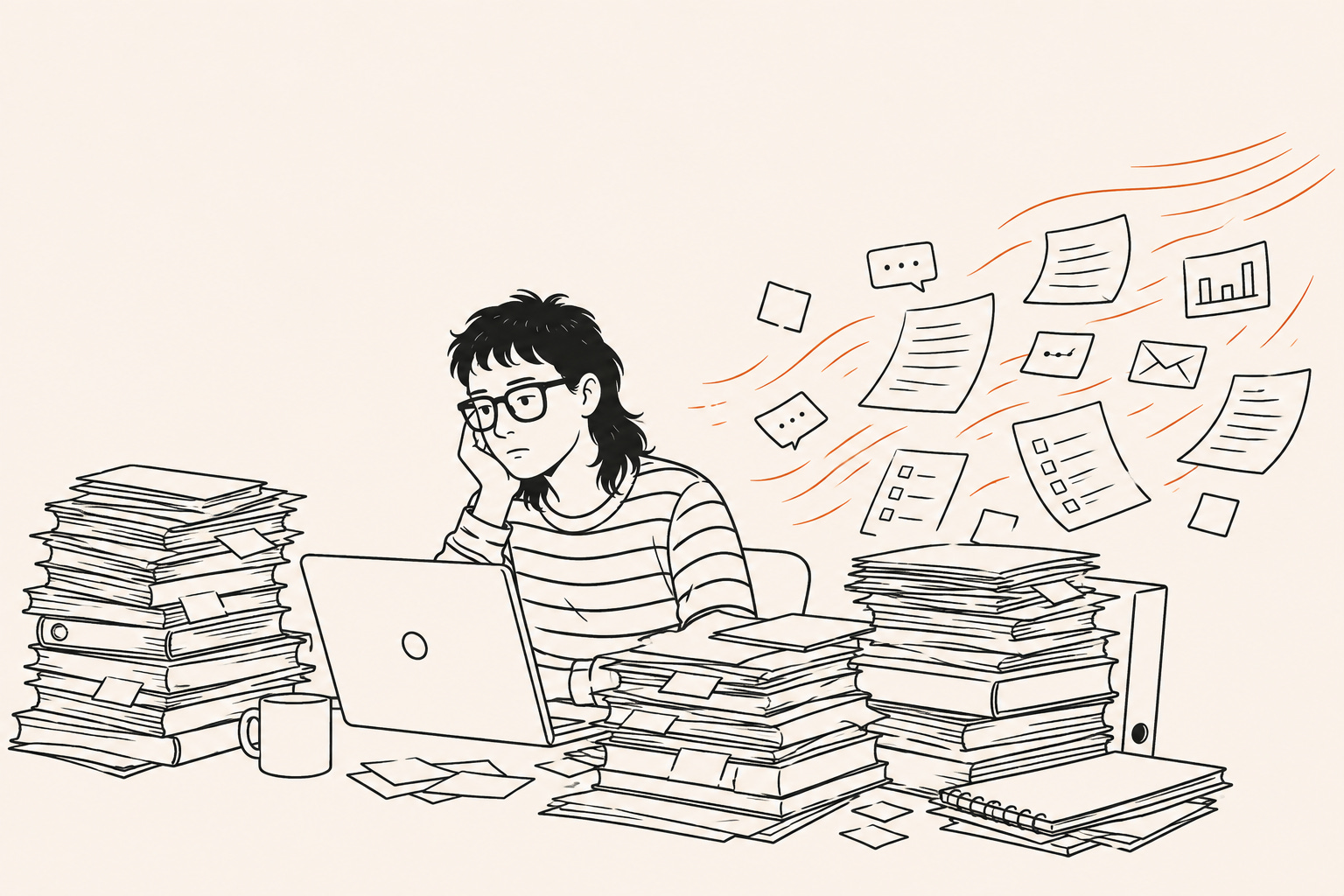
You’re at your desk. You hear a notification. It’s not Slack. Is it your AI agent, done with a task? A new email? Wait, maybe it’s a Gchat. Which tab was that in? Or is it a text message?
Your shoulders are tense, you’re getting a crick in your neck, and you start to sweat. You’ve got bigger fish to fry, though, because you missed a deadline you forgot about because you didn’t read the email from the AI agent that is supposed to help you manage your email, and you have to train on a whole new tool management is rolling out to help you “do more with less.”
The future is now, baby, and you’re working in it.
If you’ve been beating yourself up for being overwhelmed, exhausted, and confused, you’re not alone. But before you add “figure out why I’m like this” to the pile, let’s talk about paradoxes.
The current it girl paradox: Jevon’s paradox
It’s been making its way through my feed for weeks. From Hank Green, to substack’s own to NPR’s Planet Money, it’s a great big Jevonniasance.
You probably don’t remember Jevon’s first big breakout because it was in 1865.
Economist William Stanley Jevons wrote The Coal Question an unputdownable romp explaining Great Britain’s growing reliance on its favorite nonrenewable resource, circa 1865. His argument was that the more efficient coal powered engines became, the more demand there would be for them, and the more coal Britain would consume. He was right about that.1
Jevons paradox says that as an engine becomes more efficient, demand for the resource spikes instead of dropping. Tech commentators love applying this to AI: if tools make cognitive labor faster, we’ll just demand more cognitive labor. More jobs, not less! Bada boom. Done.
Here’s the thing, though: Jevon’s paradox is about coal. Coal is a nonrenewable resource with devastating climate effects, yes, but very consistent, coal. Burns at a set point, acts how you expect, every single time. Sure, it burns out, but predictably.
But people are not coal, and AI is no steam engine. People, not such a consistent resource. Much messier. They have feelings, they have physical needs, and pesky labor laws2 govern them. Right now, we’re still figuring out where the burnout breaking point is for people, and what impact that will have on <gestures around> all of this.
Meanwhile, just how efficient AI is is still in question. AI hallucinates, it needs to be checked, re-prompted, and babysat. AI creates a whole new layer of shadow-work that lands squarely on your shoulders.
So far, people are not working less. A recent BBC article on Meta’s internal AI work describes people working up to 90 hours a week building AI tools.
“You’re literally working in teams of people trying to replicate humans doing jobs,” one former employee said. That work, the person added, seems “endless.”
If AI were making people more efficient, you’d expect their workload to shrink. It’s doing the opposite. A UC Berkeley study, reported in HBR, followed roughly 200 employees at a US tech company for eight months: “AI tools didn’t reduce work, they consistently intensified it. In an eight-month study of how generative AI changed work habits, we found that employees worked at a faster pace, took on a broader scope of tasks, and extended work into more hours of the day, often without being asked to do so.”
All this to say, every bit of this is up in the air. You may be experiencing Jevon’s paradox, you may not end up jobless. But in this metaphor you’re the coal. You’re living through an extraction cycle—where unreliable tools create more friction, managers respond with more software oversight, and the worker absorbs the strain.
There’s a new girl in town: Socio-technical Burnout Paradox.3
Claremont Graduate University just released an analysis of the human cost of this recent avalanche of AI. They identified a pattern they call the Socio-technical Burnout Paradox.
Tell me if you’ve heard this one before. Big digital demands at work (tech-driven workload plus organizational and cultural pressure) erode people’s well-being, which produces paradoxical outcomes (reduced focus, slower work, lower creativity, disengagement, intent to leave), which loops back into more digital demands, because managers respond to declining performance with more oversight, more tools, tighter deadlines. The cycle reinforces itself.
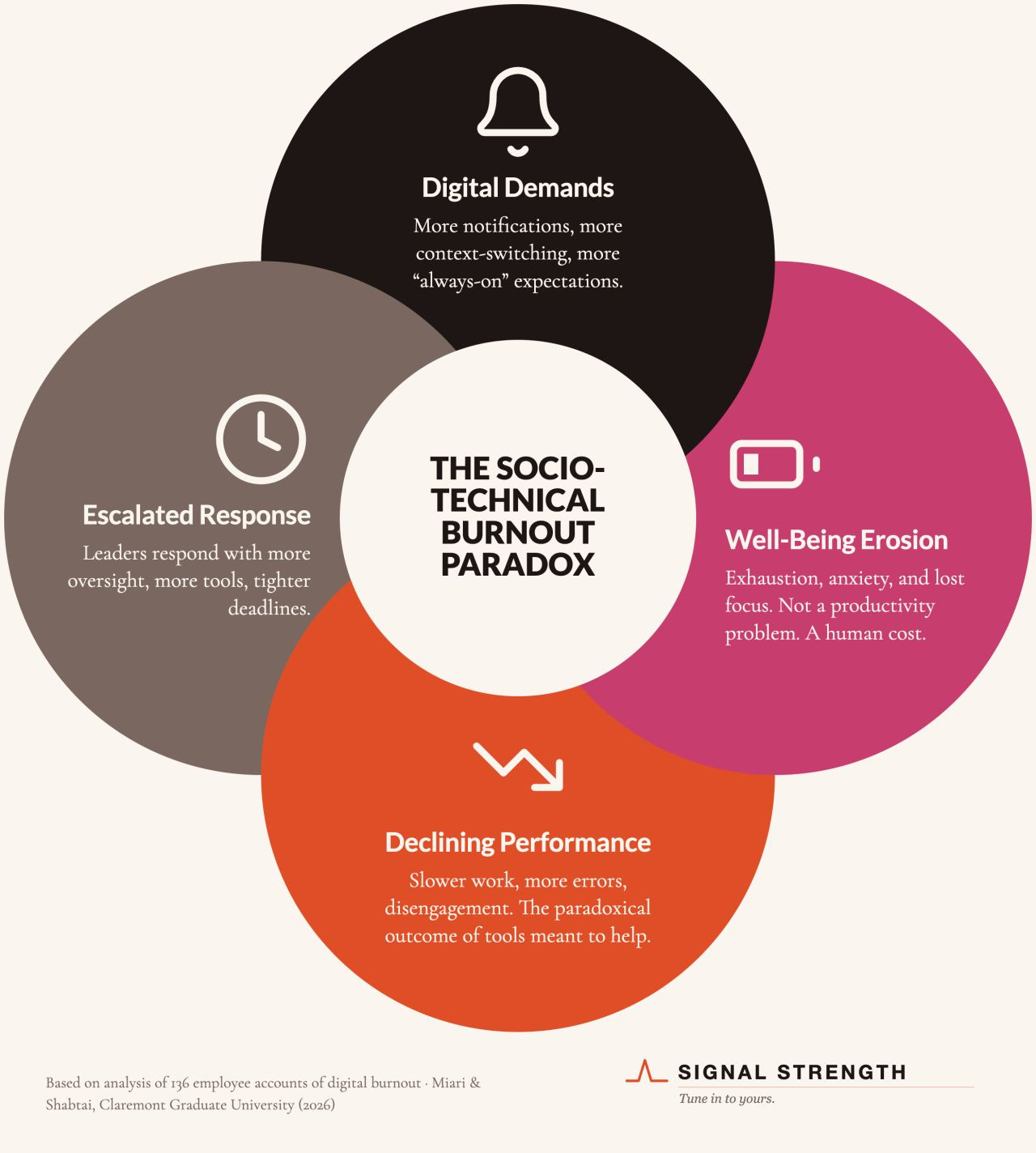
This isn’t AI’s fault. It’s certainly not yours. It’s a system grinding the humans involved into dust. The same humans who beat themselves up when they miss deadlines, who push themselves harder when they feel their energy flagging. Humans that absorb the harmful effects of the system that’s trying to build tools to replace them.
From the study: “Digital burnout is not an individual failure or weakness, but a systemic socio-technical condition shaped by the interaction of technology design, organizational structures, cultural norms, and human well-being.”
Which brings me to Linkedin (I know, but stick with me)
I posted a Business Insider piece about Silicon Valley therapists and the mental health toll AI is having on tech workers. I expected my usual engagement. (You know, like two likes from my sweetest friends and a reach of 78 people). Nope.
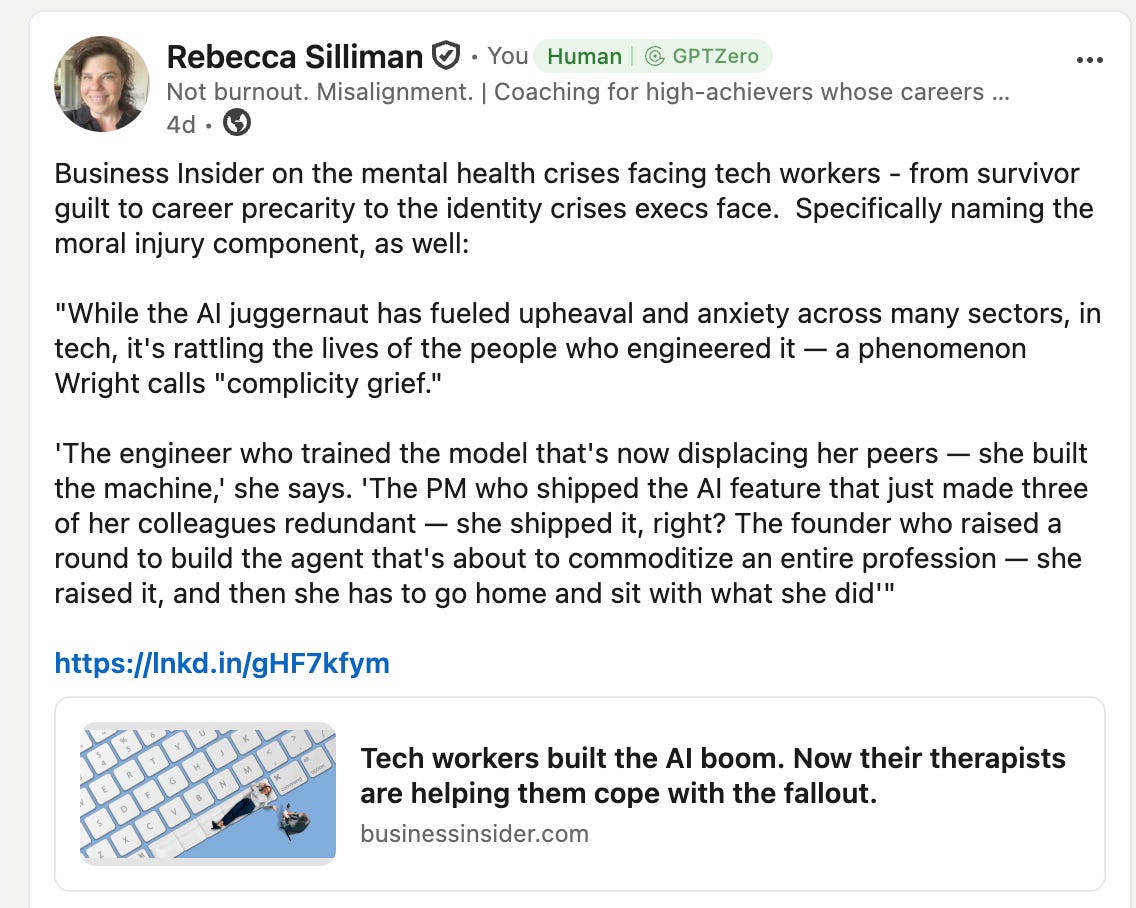

Thousands of people. Whole discussion in the comments among people I don’t even know. Multiple reposts. I hit a live wire.
People are exhausted from being told, somehow, “this is a you problem.” That burnout, moral injury, chronic stress are one workout away from being solved, if only you’d move your lazy butt.
Maybe it’s NOT me
If this is you, you are in a system that relies upon extracting a human cost from you in order to drive profits. This system depends upon you blaming yourself, upon you continuing to show up despite what emotional toll that takes on you. This is no longer about labor.
Now what? Coal never had to advocate for itself. You do. A few suggestions:
Change the tune. Instead of, “what’s wrong with me that I can’t keep up?” it’s “I can see clearly this system isn’t built for me.” Catch and interrupt self blame.
Untangle career and identity . This is where the great disentanglement comes in -- for many of us, work achievement and identity are deeply intertwined. We have built a career, a reputation, an internal model of self on being successful in work systems. Which was working, for a long time. Possibly could have worked indefinitely in the old model, despite the costs. Until AI showed up and superpowered the extraction engine. If you don’t redefine based on your values, for yourself, the system will do it for you, at the expense of your wellbeing.
Be a radically, unapologetically, unleashed thinker. If there’s one thing AI does well, it’s be boring. It does repetitive, boring tasks. It spits out smoothed-over, predictable text. Perhaps the reclaim you need now is to do the thing that the extraction engine can’t: be human. Connect with other people. Make stuff. Carving out a space for creativity is one way to fight the rigidity of systems and ease their impact on us. Ultimately, AI can work without exhaustion, it doesn’t get bored, it doesn’t need to pee. But it’s shit at hugs and rarely makes huge leaps in new thinking while taking a shower.
Consider a healthy case of the fuckits. If we can acknowledge the systemic issues, if we can disentangle our worth from the systems, maybe we can turn down the volume on fear. Also on Linkedin this week4:
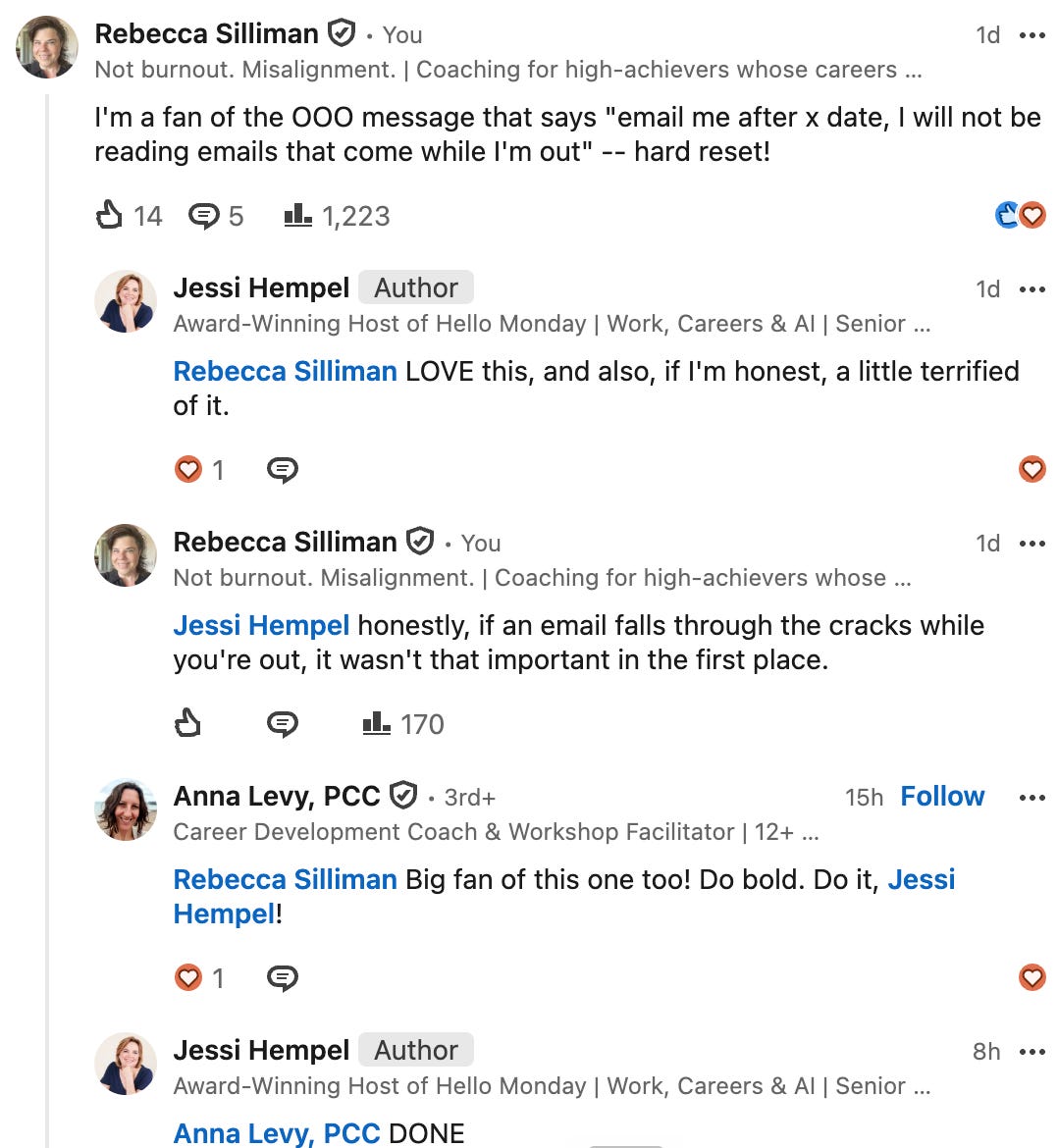
The fuckits can be small but liberating as hell. Try declaring email amnesty on your next vacation.
Try dropping a few balls. Let AI catch them.
Catalyst: A MidCareer Pivot Cohort is a 6-week cohort for people at exactly this point: mid-career, clear that something’s off, tired of processing it alone. Six live sessions, weekly work on values and strengths, a private group for the people doing it alongside you. You leave with a vision statement, a strengths map, and momentum toward what’s next.
$1,300. Six weeks, starting September 15. Capped at 8 people.
Jevon’s actual thesis at the time was that the increased demand for coal would collapse the coal industry in Britain and the entire economy. He failed to consider that they might exploit other people for the coal but who could have predicted that? Anyway, he was wrong about this part and I find that, much like a black fly in your chardonnay, ironic.
The breathless codicil in this BBC article absolutely slayed me “There are no limits in the US on how many hours a person over the age of 16 can work. In the UK and Europe, for instance, laws limit a working week to 48 hours, including overtime.” LOLSOB https://www.bbc.com/news/articles/cvgx4yd1gl2o
Rolls off the tongue.
I swear to actual God I’m not a linkedin poet but this post is really heavy on that content, huh?