The other day, a woman marched into my office and said, “The work you are doing is worthless, and everyone thinks you suck.”
It was me, I am that woman.
There is no one more brutal to deal with than our own inner critic. Yours may not be as straightforwardly critical as mine.
We call these self-critical voices our “inner critic,” but usually it’s more accurate to say “inner critics” - we have two or three who work in concert but take different approaches.
Look, it sucks to have someone in your head undermining you every time you turn around. But what you may not know is that the inner critic thinks it’s protecting you. That voice that calls you a loser, that worries about what people think, that pushes perfectionism relentlessly — believe it or not, has good intentions. Intent is a key word here – they may be undermining you to protect you from a threat that doesn’t exist.
Your inner critic is a part of you that acts like a tired and scared kid. It yells louder when you try to ignore it. Maybe all it needs is a snack, a hug, and for you to soothe its fears.
Some younger version of you received some harsh feedback or careless words from a parent, teacher or manager, some adult said something brutal and immediately forgot. Meanwhile, this specific turn of phrase got seared into your brain forever.
That version of you got the idea that achievement and impressive results would keep you safe. No one has updated it to let it know the current state of affairs.
To a certain degree, the inner critic knows their stuff – the critic got built for a reason and it may have worked. It has gotten a lot of people promoted. Of course, the inner critic’s plans for you don’t always jibe with your plan for yourself.
Research identifies six main archetypes of inner critic — at least one of them has to be eerily familiar to you.
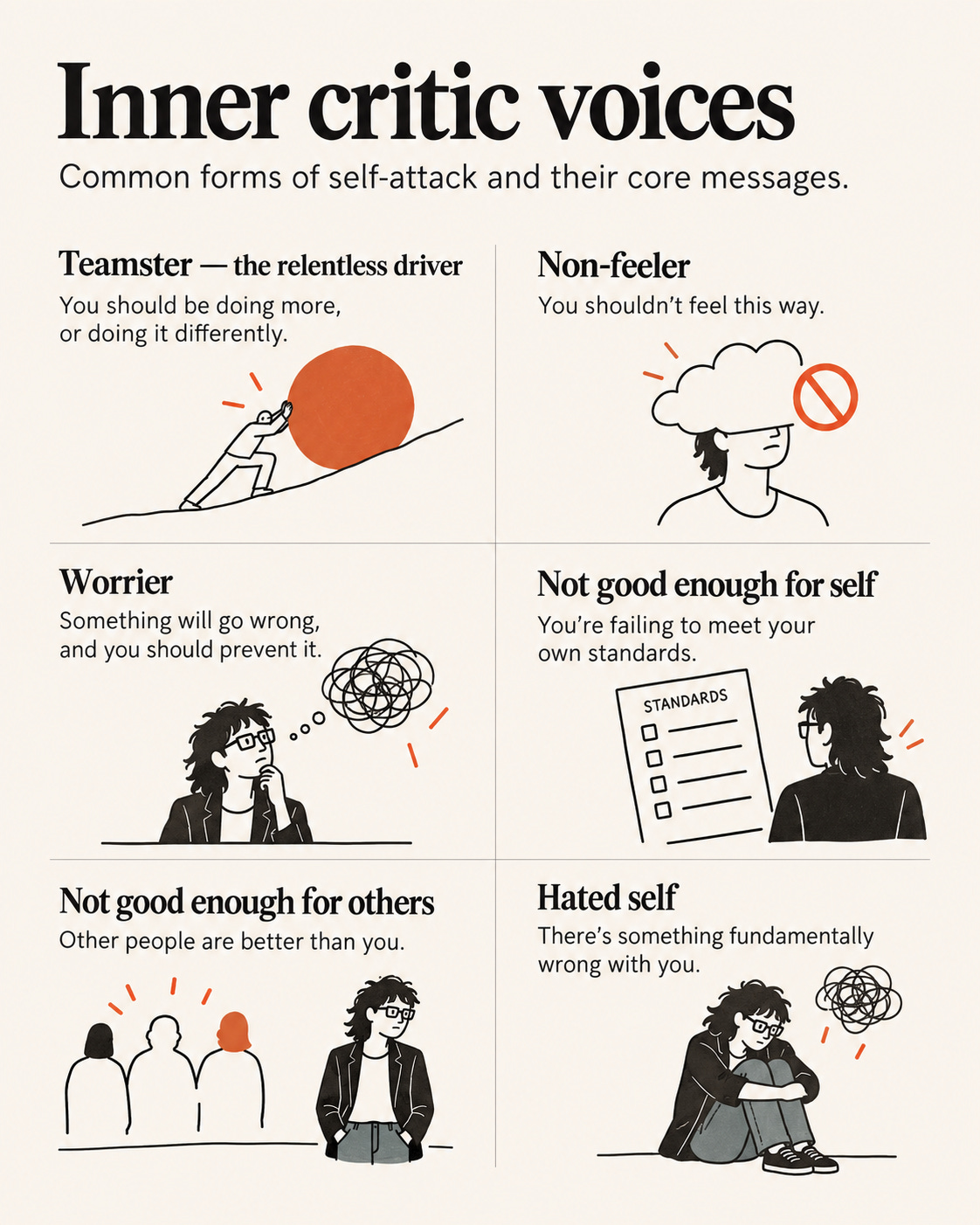
This study also looked at people who coped well with these inner demons - they identified self-compassion and self-protection, tailored to the kind of inner critic, as the central practices used by people who cope well.
Yeah, that is so generic, I see it. So I built a whole system and script for you.
The Teamster/Relentless Driver. Let’s call her Miranda.
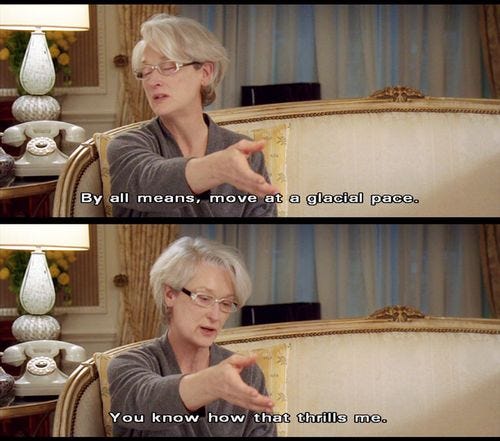
She cuts you with a look. Who knew a part of yourself that solely lives in your head could cut you with a look? But she can.
Generally, she thinks that nothing you do is good enough, nothing you wear is fashionable enough, and she’s exhausted from your incompetence.
What it looks like:
A client told me recently that, even though she was experiencing symptoms of exhaustion and depression and that she knows she needs a break, “I feel like I’m somehow lying about it and I should just be able to work through it.”
Ma’am. I don’t think you’re the one who is deciding here; seems like your body is doing that work for you.
What to do:
Take a breath. Ask yourself, what would I tell a friend going through the same thing?
You would tell them to take a few days off and rest. You would tell them that you are only human and the only way to keep achieving is to take care of your human needs.
What to tell Miranda:
Miranda, I appreciate all the opportunities you give me to achieve and I definitely will be back but I must take care of myself right now. I promise I’ll be in Paris for Fashion Week.
The non-feeler. Let’s call him Jimmy.

The inner critic who does not have time for your big feelings. Enough. DO NOT CRY! He will publicly humiliate you for crying after he publicly humiliated you.
He’s constantly yelling at you that what you’re feeling is the wrong thing and you probably shouldn’t even be HAVING any feelings in the first place.
Listen, I know Tom Hanks is America’s sweetheart or whatever but this is SUCH a dick move.
What it looks like:
I’ve been looking forward to seeing my friend at dinner for a week - then she cancelled. She had a good reason, but I’m still really upset. I should be more understanding! I shouldn’t be mad! Why do I feel this way?
What to do:
Remind yourself that feelings are human, and you’re allowed to have them. Not only that, but they are going to be there, whether you yell at yourself or not. “I was looking forward to a night out, so it makes sense that I’m disappointed. Their reason can be valid, and my feelings can be valid too. I can let myself feel hurt without blaming them or attacking myself.”
What to tell Jimmy:
Jimmy, I have a very good reason to feel the way I do. No one needs to be angry just because I feel sad. Now give me a tissue and go back to the dugout.
The Worrier. Let’s call him Cameron.

He’s pretty sure you’re going to mess it up. And get in trouble. And maybe even die as a result. He does not think it’s a good idea, whatever it is that you’re about to do. Are you sure you’ve thought it through?
Generally, he thinks you’d probably be safer in bed.
What it looks like:
You sent a proposal to a potential client yesterday. They haven’t replied.
Obviously, you charged too much. Or not enough, which is how they know you’re an amateur. You should have explained the timeline better. What if they show it to someone else? What if that person also thinks you’re an idiot?
You have now reread the email eleven times. You are hoping a twelfth reading will give you access to their thoughts.
What to do:
Give yourself one thing you can actually do. Decide when you’ll follow up. Put it on your calendar.
Then remind yourself that waiting is uncomfortable. You want the work - it’s okay to want it. You’re allowed to want it.. At this point, however, it’s out of your hands. Go eat lunch while someone else makes a decision.
Sadly, you can’t write an email so perfectly that it eliminates uncertainty from your life. I’m sorry. I would also like that email. If I find out that someone has figured out how to write that email, you will be the first person I tell.
What to tell Cameron:
Cameron, I checked the numbers, I checked the boxes, I crossed the t’s and dotted the i’s. I’ll follow up Thursday. I am not in control of someone else’s inbox. Please let me eat my sandwich.
Not Good Enough for Self. Let’s call her Paris.
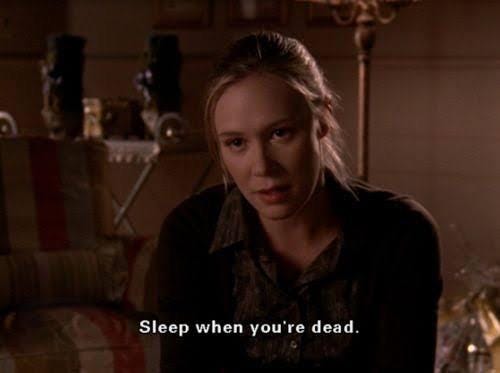
She has very high expectations of you and she fully intends you to exceed them. She’s willing to do whatever it takes and will accept nothing less than the best. She will keep you up all night writing and re-writing that presentation until it’s perfect. Other people can do “enough.” She will ensure that you do “the best anyone’s ever seen.”
What it looks like:
Your presentation was thorough and objectively excellent. People asked great questions. Your boss gave you a thumbs up.
But you stumbled over that one answer. You knew the answer, you practiced the answer. Somehow, when you opened your mouth, a different and considerably less qualified person answered.
Now you cannot stop thinking about that moment. You thought of it the whole way home. You haven’t heard a word your family has said since you walked in the door, you can’t stop berating yourself about that dumb answer.
What to do:
Notice the standard you’re holding yourself to. Who gets to decide if that answer was good enough? Because your boss was happy, your coworkers were into it and you won the account.
Give yourself permission to have a moment of being a human (instead of a perfect robot) and maybe let yourself feel good about the actual presentation.
What to tell Paris:
Paris, we are allowed to finish a presentation without receiving a standing ovation. I answered a question awkwardly. I’ll be clearer next time. Remember, successful people learn from their mistakes. How will we ever be successful without making a few to learn from? We are going to bed.
Not Good Enough For Others. Let’s call her Regina.

Regina thinks nothing you do is cool enough, nothing you wear is pretty enough, and she wants you to know that everyone is talking about you behind your back. She thinks that those shoes are fugly and that you need to lose three pounds by Wednesday.
Regina is here to fill your head with the imagined criticisms everyone around you is really thinking about you.
What it looks like:
Someone you worked with three jobs ago just announced a huge new position on Linkedin.
You were having a perfectly decent Tuesday until you saw the post. Now you’re deep-diving her substack, her entire employment history on Linkedin, and somehow her kitchen renovation.
She’s clearly more successful than you. Everyone must know it. You’re filled with shame at what they must be thinking of you.
You have acquired a remarkable amount of information about everyone’s private opinions from a photo of a woman holding a coffee.
What to do:
Step away from the app. Someone else’s curated life made you feel a sudden sense of being left behind or erased altogether.
It’s okay to gun for a promotion and dream about more prestige. But you forgot about your own kitchen filled with light in the process. Also, no one is thinking about you. I know, it’s a double-edged sword.
Also, you’re so not the only one who saw that post and had a stomach drop. That’s kind of the whole thing with social media. You didn’t fail some secret good person test.
What to tell Regina:
Regina, take a seat. I don’t need to imagine what a bunch of people are thinking, if they want to say something to me, they’re free to tell me directly. Otherwise, I’m very busy going to the mall.
Hated self. Let’s call him Bojack.

He’s pretty sure there’s something fundamentally wrong with you. He doesn’t think it’s possible that you’d be good at things or attractive to other people. He’s pretty relentlessly trying to convince you you don’t deserve recognition, safety or rest.
(Of all of these, he’s the toughest. And for the record, he’s so wrong about all that.)
What it looks like:
You forgot to reply to a friend who was having a hard week.
When you realize it, you feel awful. Then the voice starts.
Of course you forgot. You’re selfish. You always do this. You don’t deserve the friends you have.
Now you’re avoiding the reply because you feel so ashamed, which gives him even more material.
What to do:
Take a moment - it’s a missed text message. This happens every damn day. It’s the modern condition. If your friend is hurt, you can apologize. She’ll appreciate it.
If being kind to yourself feels impossible, think of someone whose kindness you trust. What would they say about this? Could you borrow their perspective for a minute, even if you can’t quite believe it yet?
Send a text. Be nice to you.
What to tell Bojack:
Bojack, I wish I’d answered sooner. I’m going to apologize and ask how she’s doing. I’m having a hard time being kind to myself right now, but I’m not going to keep helping you tear me apart.
Ready to make friends with your inner critic?
This issue names the problem: the critics running around in our heads. But naming them is only step one—learning how to manage them in real time takes practice.
Starting this week, I’m launching the paid tier for Signal Strength.
While the free weekly newsletter will always focus on naming the core dynamics—the inner critic, the ambition scam, the fear of being obsolete—the paid tier is about how to put these ideas into practice.
When you upgrade, you get:
The 5-Day Writing Challenge: Making Friends With Your Inner Critic (Starting this week—a go-at-your-own-pace guide to tuning into and turning down the volume on your critic), along with future challenges and self-guided exercises.
Practical tools, exercises, and values alignment frameworks.
Discount codes for upcoming cohorts and workshops.
(If you join as a founding member, you’ll also get a 1:1 hour-long coaching session that can be applied to future intensives.)
If you’re ready to quiet the noise and put these tools into action, upgrade your subscription today.
The content will be available to anyone who subscribes, and it’s go at your own pace, so don’t stress if the timing isn’t right yet. It will be there for you.
If this issue stirred something up, may I recommend the free Values Sort. It takes ten minutes, and you walk away knowing which values actually drive you. It’s an excellent place to ground yourself for future conversations with your inner critic.